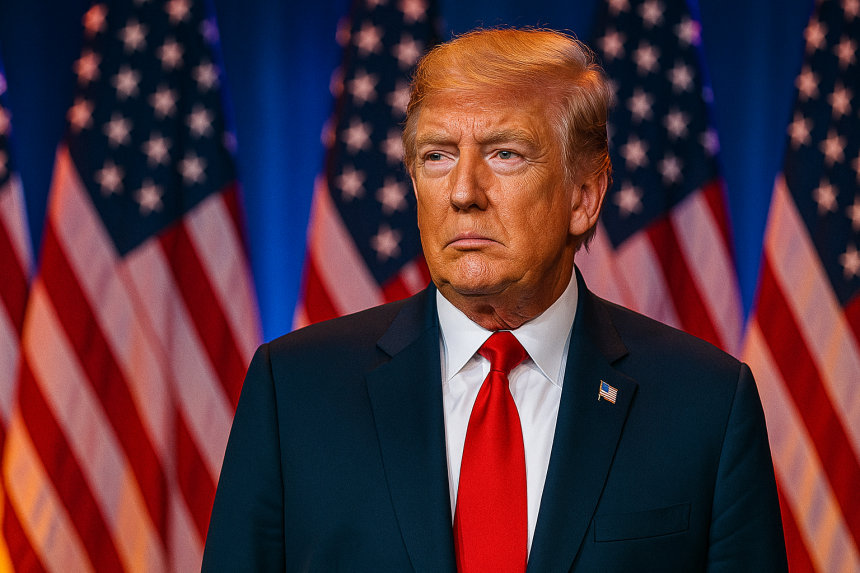
Donald Trump’s financial landscape presents a contrasting picture as his digital and golf domains experience divergent trajectories. The former President’s investments are split between tech-driven Truth Social, which is enduring notable setbacks, and his prosperous golf assets. This duality in fortunes underscores the complexity of managing diverse business ventures, where market volatility and operational profitability shape outcomes.

 ETH
ETH
 SOL
SOL
 BSC
BSC
 ROBINHOOD
 USDT
USDT
 AAPL
AAPL
In earlier assessments, Trump’s venture into social media was initially heralded as a bold counter to existing platforms, with the potential to attract a large following. However, recent reports highlight the struggles of Truth Social and its parent company, Trump Media and Technology Group, primarily tethered to volatile cryptocurrency valuations. This contrasts with optimistic projections made when Truth Social launched, aiming for significant influence in the digital space.
What Led to Trump’s Digital Setback?
Trump Media and Technology Group, responsible for Truth Social, suffered financially, reporting substantial losses largely prompted by fluctuations in its cryptocurrency assets. The financial impact has been significant, erasing $1.3 billion from Trump’s personal stake, according to estimates, despite efforts such as a proposed merger with TAE Technologies.

Efforts to recalibrate the company’s direction included forming a Bitcoin treasury and contemplating a possible spinoff of Truth Social. However, none of these moves sufficiently restored investor confidence, leaving Trump’s stake considerably devalued.
How Does the Golf Business Compare?
Conversely, Trump’s golf business tells a different story. With properties such as Trump National Doral and Turnberry seeing profitable growth, the golf operations have bolstered his financial standing. Trump’s courses, assessed at approximately $1 billion, are credited with consistent operating profits and high membership fees, strengthening this aspect of his portfolio.
Mar-a-Lago further exemplifies the seamless blend of political and hospitality business, witnessing increased valuations driven by Trump’s political exposure. A pivotal incident was the additional $115 million payment when a casino was approved on a Bronx property acquired by Bally’s, illustrating the significant windfalls achievable in this sector.
This dual trajectory vividly highlights the differing susceptibilities of market-driven versus steady cash-generating operations within a diversified business empire.