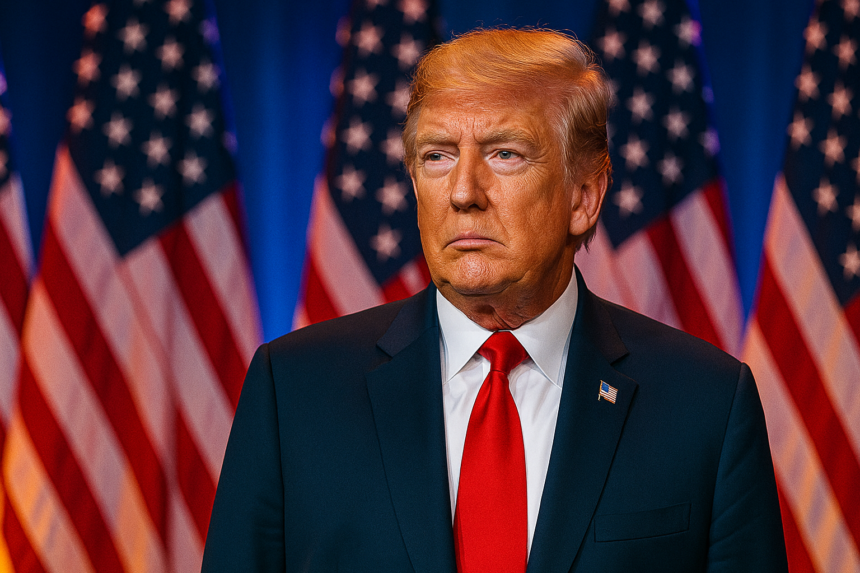
A significant step has been taken by President Donald Trump to standardize artificial intelligence regulations across the United States. On December 11, he issued an executive order aiming to prevent individual states from imposing their own AI rules, which the administration argues are hampering innovation. This order directs financial institutions and tech companies that rely on AI technologies for various operational needs towards a unified national standard.

 ETH
ETH
 SOL
SOL
 BSC
BSC
 ROBINHOOD
 USDT
USDT
 AAPL
AAPL
Why is a Unified AI Approach Necessary?
The executive order is presented as a matter of national security and economic growth, emphasizing the challenges posed by state-specific AI laws. Such regulations can lead to compliance hurdles and foster what’s described as “ideological bias” in AI models. Colorado’s “algorithmic discrimination” law exemplifies how state laws can potentially affect AI outputs to address disparate-impact concerns. Trump’s administration finds this fragmentation unviable, advocating for a national standard over 50 distinct state policies.
How Will State Regulations Be Addressed?
The administration has laid out a clear course of action to address these challenges through the formation of an “AI Litigation Task Force” within 30 days. The task force, headed by the Attorney General, is tasked with contesting state AI laws that conflict with federal priorities on constitutional and preemption grounds. Furthermore, the Commerce Department is charged with identifying and evaluating stringent state AI laws to lessen the compliance burdens they impose.

Before this directive, various strategic elements had been proposed to centralize AI regulation. Earlier suggestions included congressional efforts to restrict state-level AI laws for a decade and promote national supremacy in AI guidelines. President Trump’s administration continues to emphasize a streamlined national regulatory environment, as it also previously announced initiatives for deregulation and AI infrastructure expansion.
The new order links state policy adherence to federal funding, particularly in the context of the Broadband Equity Access and Deployment (BEAD) program. Provisions in the order allow for the conditioning of funds based on compliance with national AI standards, except where such commitments breach federal law limitations. This financial leverage aims to incentivize states to align with federal guidelines.
Further, the Federal Communications Commission (FCC) and the Federal Trade Commission (FTC) are urged to implement federal standards that preempt conflicting state laws. The FTC is tasked with clarifying when state requirements that affect truthful AI outputs could amount to federal “deceptive” conduct.
Previous discussions focused on creating a consistent framework for AI deployment across state lines, reflecting the administration’s current deregulatory trajectory. The new order reinforces prior efforts such as the AI Action Plan introduced by Trump, which emphasizes deregulation and advocates for AI-driven governmental efficiencies.
“The order’s intention is to address regulatory inconsistencies that hinder innovation,” said the White House.
“Ensuring a unified AI policy is vital for economic growth and national security,” the administration stated.
These directives manifest a strategic push for a cohesive federal AI policy that overcomes state-imposed limitations, crafting a landscape conducive to broad technological advancement.