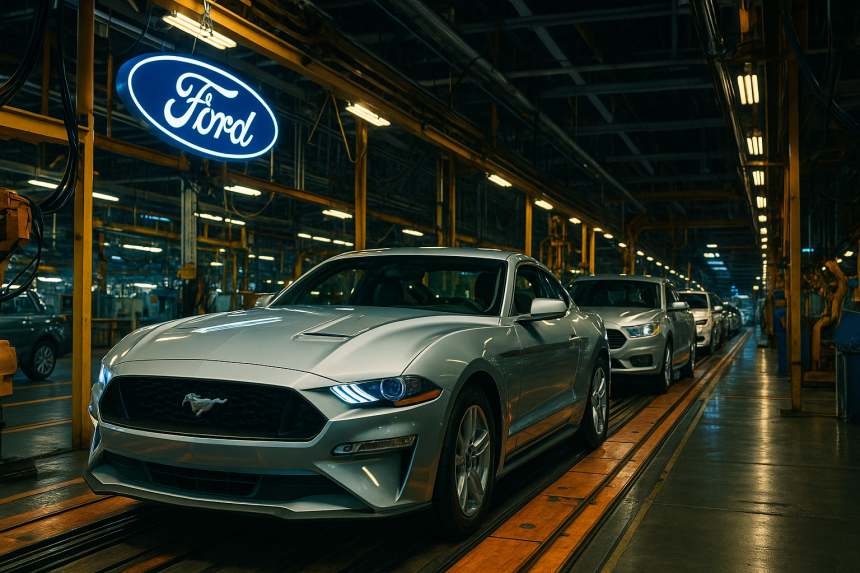
Ford is grappling with significant financial setbacks due to its strategic focus on electric vehicles (EVs) and external challenges such as tariffs and supply chain disruptions. Amid readjusting its approach to meet shifting consumer preferences and new federal guidelines, Ford’s recent quarterly outcomes represent a considerable deviation from its pre-pandemic achievements. These developments signal underlying complexities within the automotive industry as manufacturers try to balance innovation with profitability.

 ETH
ETH
 SOL
SOL
 BSC
BSC
 ROBINHOOD
 USDT
USDT
 AAPL
AAPL
Previously, Ford’s aggressive investment in its EV division marked a decisive move aligned with industry trends, seeking to establish its foothold in a rapidly growing market. However, past ambitions projected higher consumer demand than actualized, necessitating Ford to recalibrate its strategy. The company’s $11.1 billion net loss in the fourth quarter reflects a strategic realignment as well as external cost pressures not fully anticipated at the outset of its EV initiative.
How Is Ford Adjusting Their Strategy?
Ford has undertaken a pragmatic shift, cutting production of its electric F-150 Lightning while emphasizing hybrid vehicles and cost-effective EVs. This decision, resulting in a $19.5 billion write-off on its EV assets, aligns with Ford’s intention to redirect funds into more promising avenues. Among these are American-built trucks and hybrid models that promise higher margins. Despite transitioning plans, Ford is steadfast in its EV ambitions, as indicated by CFO Sherry House’s statement that the EV division may reach break-even by 2029.

What Are the Impacts of Tariffs and Supply Chain Challenges?
The implications of tariffs have been severe, contributing to an additional $900 million loss for Ford. This was further compounded by fires at an aluminum plant critical to Ford’s supply chain, leading to increased dependency on imported materials. Such factors signify broader uncertainties within the automotive sector’s infrastructure and emphasize the amplified costs manufacturers encounter amidst geopolitical and logistical disruptions.
CEO Jim Farley underscored the necessity of capital realignment, stressing collaboration and strategic investment as primary actions. Ford’s upcoming initiatives include a cost-effective $30,000 EV platform and strategic partnerships in selected markets to bolster profitability and market presence. Farley noted,
“I do believe this is the right allocation of capital. It’s a combination of partnerships where it makes sense, efficient partial electrification investments where we have revenue power, and really hitting the EV market in the core.”
This approach reflects an industry-wide recognition that diversified ventures may mitigate risk while sustaining innovation.
This realignment comes at a critical juncture where Ford’s foresight and adaptability will be regularly tested. The intersection of evolving technological advances and economic trends means that the automaker’s recent decisions could set precedents in sustainable automotive development. Given the inherent volatility of the automotive market, careful observation of these unfolding strategies will offer insights pertinent to industry dynamics.
Ford’s allowance for adaptability highlights an acknowledgment of intricate market and operational landscapes, guiding its transitional strategies. As the company navigates these complexities, the success of Ford’s recalibrated initiatives will depend significantly on consumer acceptance and effective management of supply chain dependencies. As Farley aptly noted,
“I think the customer has spoken. That’s the punchline.”
This recognition underscores the ongoing dialogue between consumer needs and industrial advances Ford must balance to regain fiscal stability.