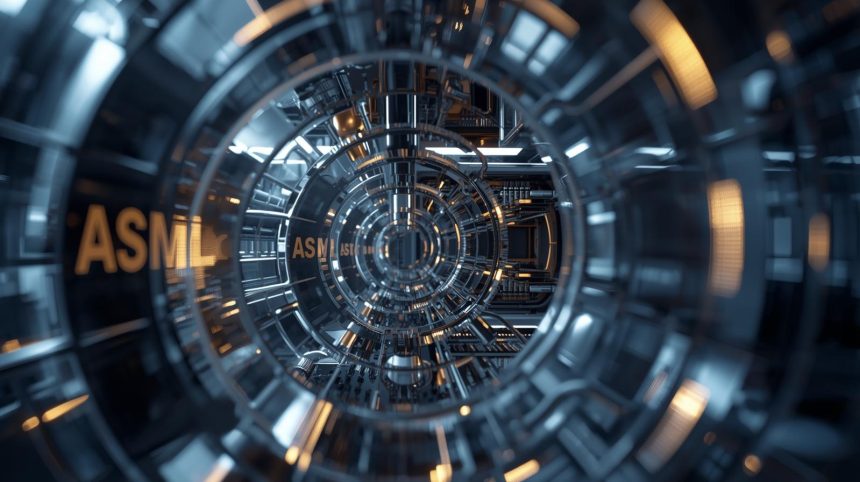
In the quiet Dutch municipality of Veldhoven, ASML (NASDAQ:ASML) stands as a pivotal player in the semiconductor world. This company, not widely known to the general public, solidifies its position by providing crucial EUV lithography machines used in the production of advanced computer chips. Each machine, priced at approximately €350 million, doesn’t emerge from a lonely factory line in the Netherlands; rather, it is a feat of global collaboration, calling upon over 5,000 specialized partners and suppliers worldwide to craft its intricate systems.

 USDT
USDT
 AAPL
AAPL
ASML’s approach, often seen in the public eye as a unique innovation, relies heavily on a vast network of global contributors. Years of collective expertise and thousands of interdependent technologies across continents have been woven together, allowing the company to maintain its status as a leader in lithography technology. Historically, ASML invested in innovation, acquiring companies like Cymer for light source technology and relying on its enduring relationship with ZEISS for optics, which has fortified its competitive edge.
What makes ASML’s approach special?
ASML did not conform to traditional manufacturing methods. Instead of striving for self-sufficiency, the company strategically collaborated with numerous external firms to source highly specialized components. This methodology allowed ASML to focus on the overall system architecture while fostering a rich ecosystem of suppliers. By partnering with companies such as ZEISS in optics production, ASML ensured that its machines could project intricate patterns onto silicon wafers, crucial for crafting components in modern electronics.

How does EUV technology work?
EUV lithography is a process using extremely short wavelengths of light to etch microscopic patterns onto silicon wafers. These patterns underpin the operation of processors in various tech devices. ASML’s systems, featuring 13.5-nanometer light waves, achieve this by using a sophisticated sequence of light generation involving molten tin droplets and laser pulses resulting in EUV light emission.
ASML’s EUV systems contain advanced reflectors from ZEISS that are devoid of glass and function under vacuum conditions. These precision-engineered reflectors are essential due to their ability to bounce light efficiently, ensuring that the intricate designs are transferred onto wafers without distortion, a feat not easily replicable by competitors.
Integration remains a complex challenge. To ensure seamless operations, ASML’s engineers meticulously assemble and test major modules, ensuring that mechanical and software systems work in concert. This integration enables rapid yet precise wafer processing, driving efficiency in global semiconductor factories.
The unique conglomeration of expertise at ASML makes it difficult for competitors to reproduce its machines. With decades of experiential knowledge embedded in its technology and supply chain networks, the company maintains an advantageous position. Replacement parts, ongoing support, and tailored software solutions further enhance the offerings.
ASML’s latest High-NA EUV systems illustrate its commitment to progress. By increasing the numerical aperture, these machines can print smaller features on chips, enabling advanced logic and memory development. This reinforces ASML’s commitment to evolving semiconductor processes by pushing the boundaries of what is technologically plausible.
As ASML continues to expand and adapt to the demands of the semiconductor industry, its strategic partnerships and innovative technology ensure it remains an essential player. By leveraging a global network and years of research, ASML not only drives innovation but also holds significant influence over the industry’s future trajectory.