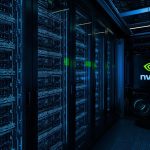
The tech industry eagerly anticipates Nvidia (NASDAQ:NVDA)’s latest announcement at its GTC Technology Conference in San Jose. As AI continues to evolve, Nvidia is shifting its focus to innovations that cater to emerging needs in the field. The spotlight is on CEO Jensen Huang’s keynote, where a significant unveil is expected. With speculation mounting, the question remains: what strategic moves will Nvidia reveal to maintain its position in the AI landscape?

 ETH
ETH
 SOL
SOL
 BSC
BSC
 ROBINHOOD
 USDT
USDT
 AAPL
AAPL
In recent years, Nvidia’s trajectory in AI has broadened beyond its dominating GPU market. Historically focused on parallel computing, the company’s recent ventures signal a move towards a comprehensive AI infrastructure. This shift is reflected in a new deal with Meta (NASDAQ:META) Platforms to scale its Grace CPUs and upcoming Vera servers, marking a significant strategic expansion. Nvidia’s evolution could potentially redefine its market presence, aiming to capture new avenues within the AI realm.
What is Nvidia’s Announcement?
Anticipation centers around Nvidia’s possible introduction of an AI-optimized CPU, possibly named the Vera CPU. This new chip may address the needs of agentic AI workloads, a growing area requiring efficient sequential execution rather than traditional parallel processing. The launch would signify a new chapter in Nvidia’s AI strategy, aligning with an earlier agreement with Meta to deploy CPUs tailored to AI-specific needs.

Are AI CPUs a Game Changer for Nvidia?
An AI-optimized CPU represents a strategic diversification beyond GPUs, which have long anchored Nvidia’s success. Such a move opens up new revenue streams and positions the company to benefit from the increasing demand for agentic AI systems.
Nvidia’s CEO stated, “This development brings us closer to bridging the gap between efficient AI processing and real-world applications.”
The collaboration with Meta alone demonstrates the potential ripple effects across the tech industry, inviting broader enterprise engagement.
Some investors remain skeptical, questioning whether the announcement will significantly impact Nvidia’s stock value. Analysts highlight that Nvidia’s market expectations are already high, and altering the existing narrative requires more than incremental innovations. Despite this, the emphasis on AI platforms implies a longer-term growth potential.
“While the stock impact may be debated, the AI platform’s long-term benefits are unquestionable,” said an industry analyst.
During this revealing period, Nvidia seeks to transition from a GPU-centric company to a full-stack AI provider. The unveiling of the Vera CPU hints at broader ambitions within AI spaces, underscoring the need for refined, low-latency execution in AI processing.
Nvidia’s drive toward AI infrastructure goes beyond GPUs and CPUs, suggesting a keen focus on creating a balanced platform for emerging tech demands. This clear expansion outside traditional confines reflects an adaptive strategy to sustain its competitiveness as AI and technology advance.
The move signals an interesting period for Nvidia as it embarks on a path to integrate more thoroughly into AI architecture, a potential pivot that could redefine its contribution to tech infrastructures. While stock movements might not show immediate impact, the strategic undertaking emphasizes Nvidia’s role in shaping the AI world efficiently.